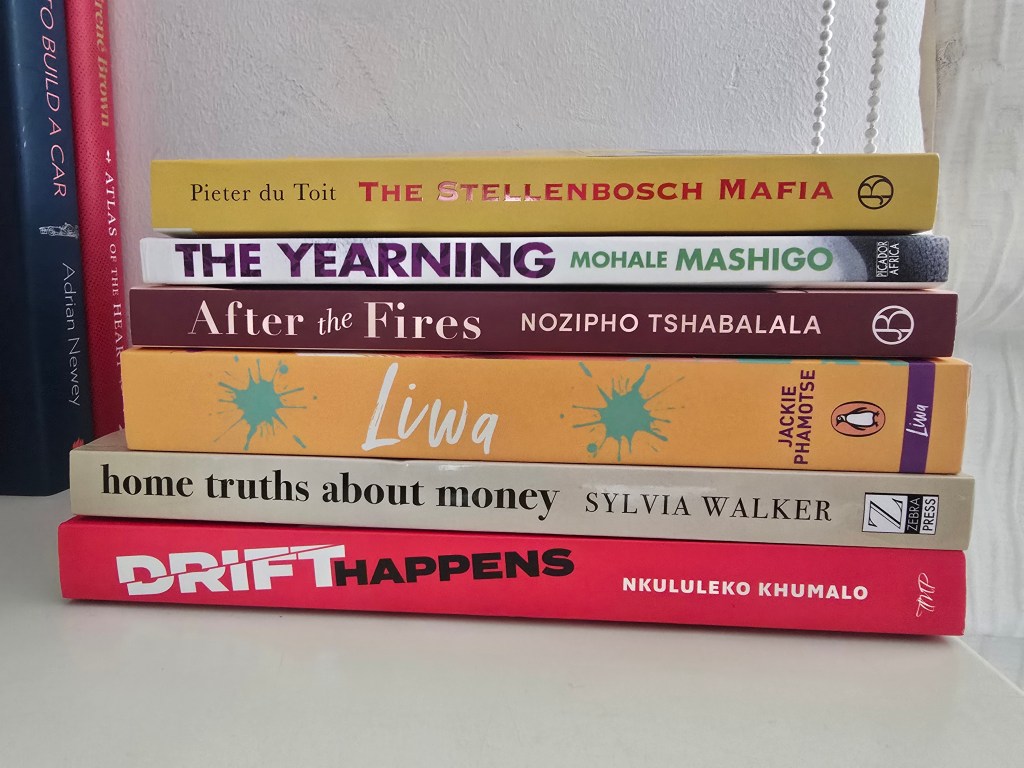
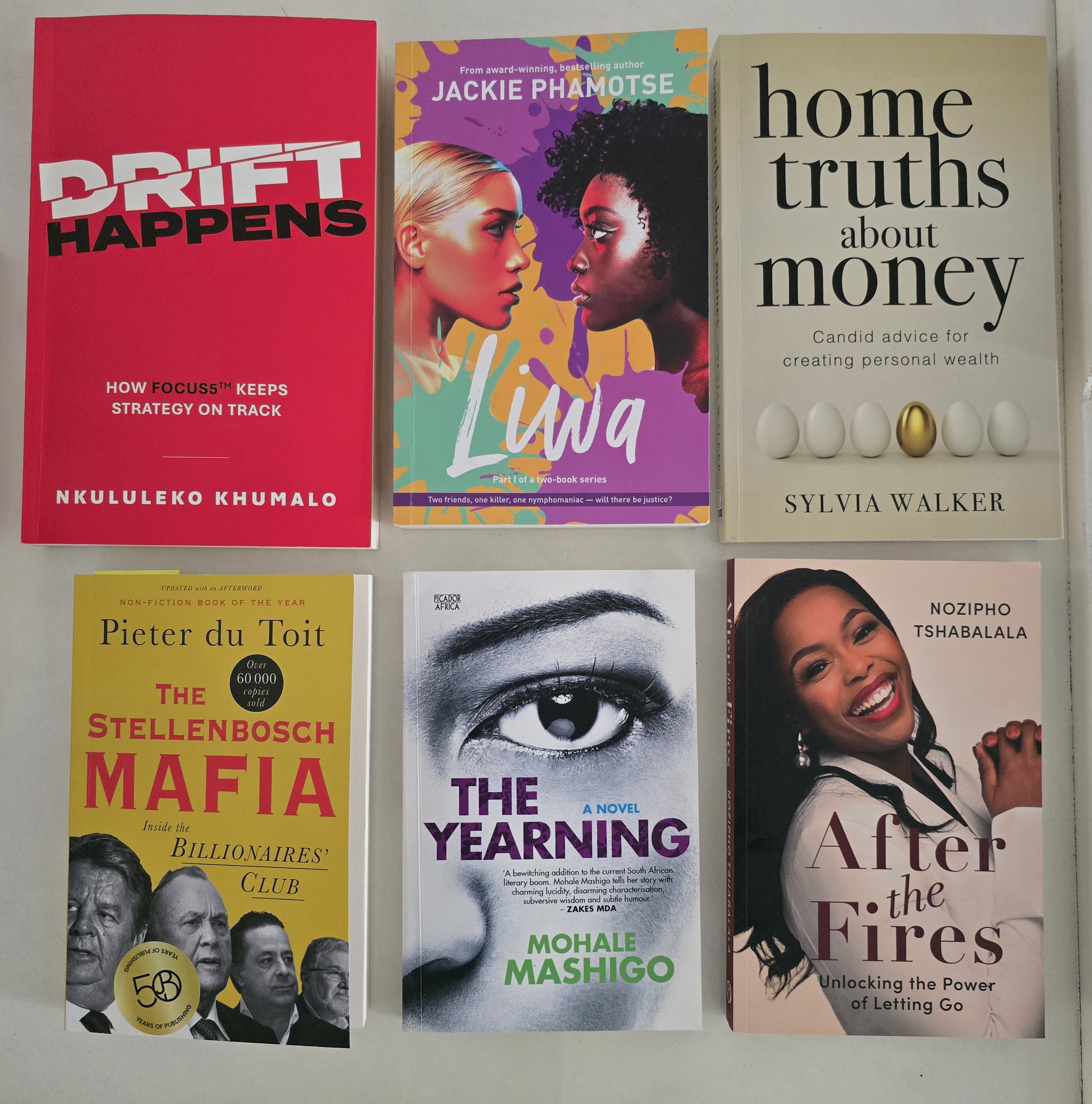
This Heritage Month, I found myself immersed in books by proudly South African authors—stories that reflect the complexity of who we are, from culture and spirituality to identity, business, privilege and the realities that continue to shape our society.
1. Home truths about Money – Sylvia Walker
- Informative
- 4 Stars
‘Managing money is not rocket science, its basically common sense. But while common sense may be common, acting on it is not.’
Every decade my relationship with money continues to evolve. As I’m approaching my 50ties my priorities have shifted and my primary goal is to ensure I have enough money saved to maintain the lifestyle I want to lead at retirement. Not an easy task when you are an entrepreneur but I always try to remember the end goal.
The one money advice I learnt when I embarked on the entrepreneurial journey was that cash flow is king.
When you bring personal finances in the mix, my business mentor used to say ‘Not having money is such an inconvenience. Money gives you freedom and it enables you to just move differently.’
Home truths about Money by Sylvia Walker is straightforward advice about understanding money, how it works, how money weaves its way through almost every aspect of our lives and making smart money decisions that guide in building personal wealth.
Like most books that give advice on a topic, certain chapters (Home Truth) will hit more that others and for me, the following Home Truths resonated with me the most.
- Home Truth #1: Having lots of money doesn’t make you rich
- ‘Most of us don’t come from money, so we must build our wealth over time.’ This home truth delves on building your Net Worth.
- Home Truth #4: Respect your money and it will respect you
- ‘Money gives us security and creates freedom if we manage it well.’ We need to see money as a tool to create wealth.
- Home Truth #11: If you don’t control your money, it will control you
- ‘Use money as a tool to get the life you want instead of chasing money to survive.’
- Home Truth #23: Equity investing build long term wealth
- Great chapter on understanding equity investing.
- Home Truth #27: Your retirement plan will never be perfect
- I have been intentional with how I use my money now that I can see retirement in my horizon. The next 20 years in all about working smarter to save money towards my retirement and I understand now more than ever that this will never be perfect.
Because we live in a world of information overload and bombarded with everyone claiming to be an expect, books like Home Truths about Money are important as they help debunk some myths that filter in our lives from people who claim to be expects on social media.
2. Drift Happens – Nkululeko Khumalo
- Engaging
- 4 Stars
‘Most organisations don’t have a strategy problem, they have an execution problem.’
Finally someone said it and wrote about it.
Having spent over two decades working in a corporate environment and later consulting to corporates, the above statement reflects the sad reality of many organisations. I’ve seen beautifully presented, well-articulated strategy documents that get employees excited, only for it all to fall apart when it comes to execution.
What I like about this book is that Nkululeko lays the foundation from the onset. He sets the tone by opening with a ‘day in the life’ scenario of Emma. Then there’s Ravi, who has his own challenges figuring out what to focus on for the week. These scenarios immediately feel familiar because people in corporate environments are constantly juggling competing priorities and projects.
In some instances, they also have leaders with what we call an ukubamba uyeka (hold-and-let-go) mentality towards projects or campaigns. There is no clear direction on how the strategy will be executed, priorities constantly shift and teams move haphazardly from one project to another. Employees are left running like hamsters on a wheel – busy, but not necessarily moving forward. As Nkululeko puts it: ‘Drift Happens.’
‘Busyness is the most visible form of work.’
Nkululeko brings it back to the importance of focus and the critical role leaders play in creating it. Importantly, he argues that focus should not simply be left to the individual; leaders need to create an environment that enables it. Focus is a design choice.
He introduces five moves that help drive results – Frame, Own, Cadence, Unblock and Sustain – the Focus5™ framework designed to keep strategy on track. For each element of the framework, he provides examples of organisations and governments that have successfully executed strategy, moving the concept from theory into practical application.
The book then goes beyond explaining the Focus5™ framework and explores what it takes to embed these principles into sustainable organisational behaviour. This, for me, is where the conversation becomes particularly important. A framework can provide direction, but ultimately it is leadership behaviour, organisational discipline and consistency that prevent strategy from drifting.
‘Strategy doesn’t fail all at once; it drifts – and drift is entirely within a leader’s power to prevent.’
Anyone who deals with strategy—from the C-suite to operational teams, department heads, strategy professionals and consultants—will find value in this book.
This is the type of book you keep within reach as a reference point, particularly when developing strategy, managing competing priorities or trying to understand why a seemingly brilliant strategy is simply not delivering the intended results.
It’s well written, well structured and, fittingly, meticulously executed.
3. The Stellebosch Mafia – Pieter du Toit
- Compelling
- 4 stars
A lot has been said about the existence of the so-called Stellenbosch Mafia and the power and influence its members hold in South Africa. When Julius Malema spoke about the Stellenbosch Mafia during the 2014 election campaign, the phrase gained greater prominence and, with it, curiosity about who these people were and just how much influence they wielded.
In the wake of the Steinhoff scandal, that curiosity intensified. Suddenly, there was even greater interest in the names and faces associated with the Stellenbosch Mafia – a term frequently used in conversations about South Africa’s economy, wealth and, ultimately, who holds real economic power in the country.
Pieter du Toit does a brilliant job of providing the backstory of where it all began and putting faces to some of the individuals who supposedly ‘belong’ to this group.
His conversations with the likes of Rupert, Durand and Hertzog, to mention a few, offer fascinating insight into how these individuals think, how they view South Africa and, perhaps most interestingly, how they view themselves and one another.
My takeaway is that what is referred to as the ‘Stellenbosch Mafia’ is, in many ways, an old white boys’ club built on powerful networks and relationships. That does not take away from some level of business acumen these individuals profiled might possess, but the book also made me think about the role of access and their privilege. Networks open doors, and historically, those doors have not been equally accessible to everyone in South Africa.
‘Our overriding concern was to prove that by standing together, we (i.e. Afrikaners) could take our place in the business world with dignity and honour.’
And perhaps one of the lines that best captures what stood out for me:
‘…influential networks not only open doors, but provide a safety net, too…’
That observation stayed with me because it speaks to something much bigger than the idea of a ‘mafia’. It is about the power of networks – who has access to them, how they are built and sustained, and the advantage they can provide across generations.
A compelling and fascinating read. I thoroughly enjoyed this book.
4. After the fires: Unlocking the Power of Letting Go – Nozipho Tshabalala
- Evocative
- 4 Stars
I bought Nozipho’s book after attending her talk at the Franschoek Literacy Festival earlier in the year. She gave an honest, heartfelt account on her journey and how she ended up writing her book. I knew I had to read it.
Her book has been on my TBR and when heritage month started, I was intentional about reading books by South African Authors, and glad I did.
I love how Nozipho’s tells her story, it’s captivating and evocative. From a young age having to navigate so much – fleeing your home, taking on a new identity, acclimatising to new environments (school, varsity, work), healing from trauma, loss and having to adult – it’s a lot. Not many people are able overcome their hardships and build a successful career.
Nozipho uses her story to show that an over-reliance on control is rooted in fear and self-doubt. She details the psychological shift from using control as a necessary shield to realising that it has become an emotional cage. Control gave her the illusion that she could out-engineer suffering – that if she just worked harder, planned better and remained flawless, she could protect her life from falling apart.
When you see Nozipho facilitating or MCing an event, she carries herself with the confidence and polish of someone who may have grown up privileged. Yet her story is far from one of privilege. uNozipho used every opportunity that came her way to change not only the trajectory of her own life, but that of her family too.
The sad truth about Nozipho’s story is that certain aspects of it are deeply relatable within the South African context, particularly for a Black girl who is also a first-born child. The weight of responsibility, expectation and the pressure to succeed often extends beyond oneself to the entire family. That is why I feel this book is so important.
5. Liwa – Jackie Phamotse
- Gripping
- 3.5 Stars
How Jackie Phamotse creates characters needs to be studied…goodness gracious. Liwa and Noels characters are so dark it’s frightening.
Liwa Nile and Noel Glass are childhood friends who grew up together in the villages of Port Alfred. Both have managed to overcome challenging childhoods and, on the surface, have built successful lives for themselves.
Liwa is an architect with a thriving career, while Noel is an artist who creates captivating pieces. Together, they have built a successful business. But behind that success lie deep, dark secrets. Their past trauma and pain have profoundly shaped who they have become and how they navigate the world.
‘Friendships that are built in blood bondages need more than loyalty to survive.’
Liwa and Noel believe their friendship is built on love, and perhaps that was true when they were younger. It would explain the lengths they are willing to go to for each other. But as they grew older, I felt their friendship evolved into one of dependency rather than love. They enable each other in ways that are ultimately destructive. I found their friendship deeply toxic.
‘Love can only save you if you break free from mental bondages.’
What makes their story even more heartbreaking is that they both have people in their lives who genuinely love them—people who show them that love can have the power to heal and help you become a better version of yourself. Yet neither Liwa nor Noel seems able to fully embrace this. Instead, they remain trapped by their past pain and the emotional patterns it has created.
‘Love can only save you when you know what it is.’
And perhaps that is at the heart of their story: how do you recognise healthy love when pain, trauma and dependency are what you have always known?
Jackie Phamotse’s storytelling will have you hooked as though you’re binge-watching a gripping TV series. I could not put this book down. The characters are complex, disturbing and fascinating, and just when you think you understand where the story is going, it pulls you deeper into their darkness.
I cannot wait for Book 2 because that ending was a cliffhanger of note!
6. The Yearning – Mohale Mashigo
- Thought-provoking
- 3 Stars
‘Stories matter and so do the voices of storytellers.’
I grew up in a time when ‘having an ancestral calling’ was rare and often misunderstood. Over the years, society has become more understanding and accepting of individuals who have ancestral callings. You see it in the growing number of people openly embracing the journey of ukuthwasa.
The reason I mention this is that in The Yearning, Marubini (Rubi), the main character, begins to exhibit signs of having a calling. She finds herself in a state of uncertainty about who she is and who she is meant to be. As the story unfolds, she begins to yearn for the truth about her upbringing and her family.
‘Something dark has been lurking in the shadows of Marubini’s life from as far back as she can remember.’
As a young woman working in marketing and living in Cape Town, Rubi is also navigating the challenges of everyday life. She has a complicated relationship with her mother, while her relationship with Pierre is critical but stable. At the same time, she is carrying grief—the death of her grandfather, Ntatemoholo, and the mysterious disappearance of her father, Baba.
What I found particularly interesting is how these seemingly ordinary struggles exist alongside something much deeper: Rubi’s search for identity and her connection to her ancestry. As she begins questioning what she knows about herself and her family, the past slowly starts making its way into the present.
There are many twists and turns in this book that will keep you captivated and turning the pages, particularly as the mysteries surrounding Rubi’s family begin to unravel.
The Yearning is a thought-provoking read about identity, ancestry, grief and the complicated journey of discovering where you truly come from. Mohale Mashigo’s writing is deep and captivating, weaving the spiritual and the everyday together in a way that makes Rubi’s journey feel both deeply personal and much bigger than herself.


Leave a Reply